
Would You Trust an Agent to Buy Your House?
Lessons from building an agentic lawyer, from our talk at the London Agentic AI Meetup

July 8, 2026
We’re hiring! Explore our Product Engineering Guide to learn how we build at Orbital.
Would you trust an agent to buy your house?
It is a deliberately provocative question, and it is the one Toby Dickinson Williams and I put to a room full of engineers and AI enthusiasts at a recent Agentic AI Meetup, run by Xcede and hosted by Orbital at our new London HQ. Buying property is one of the most consequential (and frankly, onerous) things most people will ever do. It is high-stakes, judgment-laden, and unforgiving of mistakes — exactly the kind of process that should make you pause before handing the keys to an AI agent. Which makes it a very good place to think hard about what it takes to build a genuinely capable agent.
Here at Orbital, we build AI that performs the complex legal due diligence required to facilitate commercial real estate transactions, so this isn’t just a thought experiment for us. This post is a written tour of that talk: what a property lawyer actually does, how you might equip an agent to do each part of it, and what building an “agentic lawyer” taught us about building agents in general — including the coding agents that can now debug and improve our own product while we sleep.
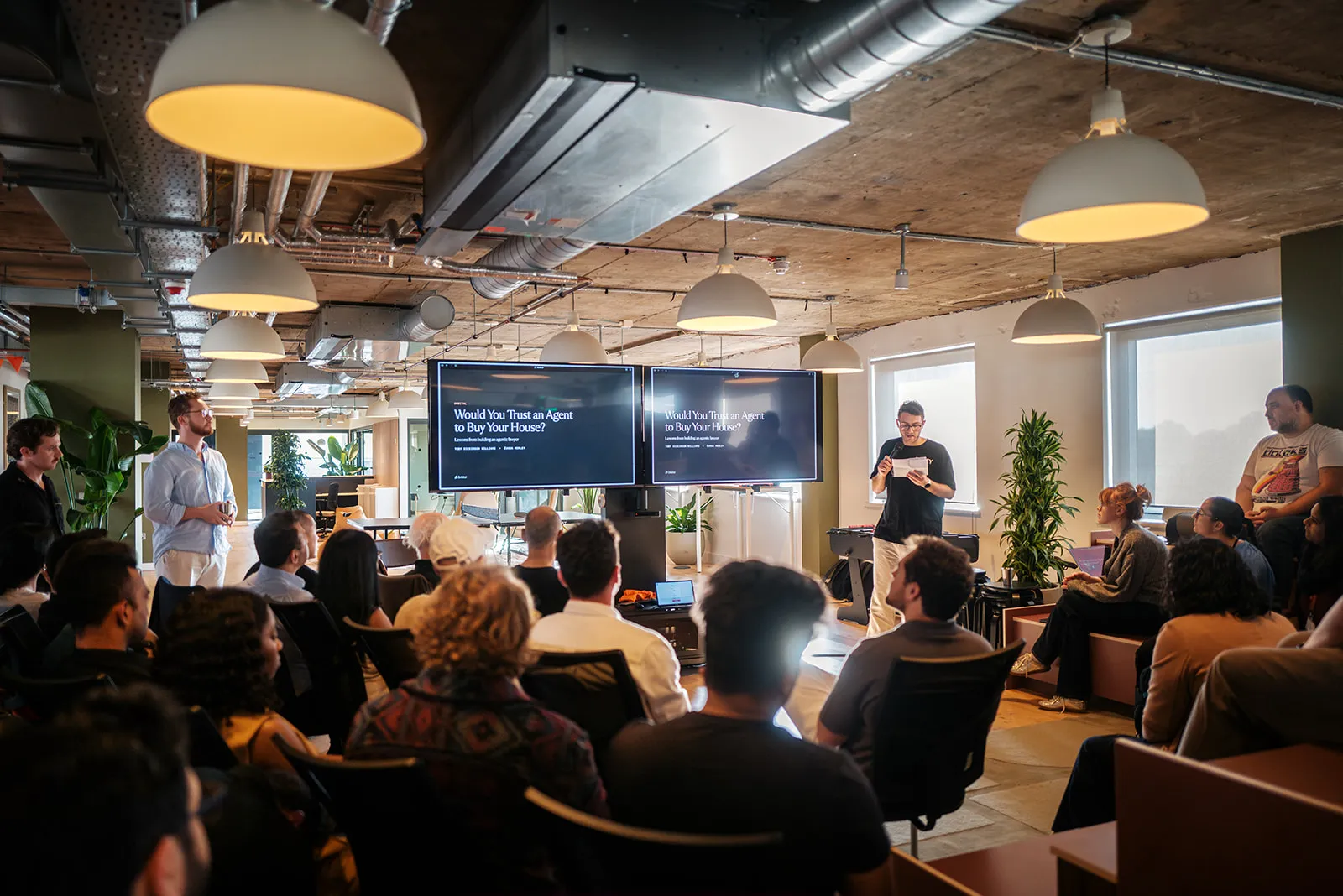
The London Agentic AI Meetup. One provocative question — and a bucket of squishy houses to give away.
Meet the client: Dame Judi Dench buys the Shard
Every good talk needs a story. So with the help of some particularly creative audience participation, we came up with a memorable one. Dame Judi Dench has decided that she would like to purchase the Shard in order to open London’s one and only mega-casino. She sets her best real estate lawyer to the task.
It is a silly premise with a serious point. Whether the client is a national treasure buying a London landmark or a first-time buyer purchasing a two-bed flat, the lawyer’s job can take on a broadly similar shape — and it is a great deal more than “read the contract.”
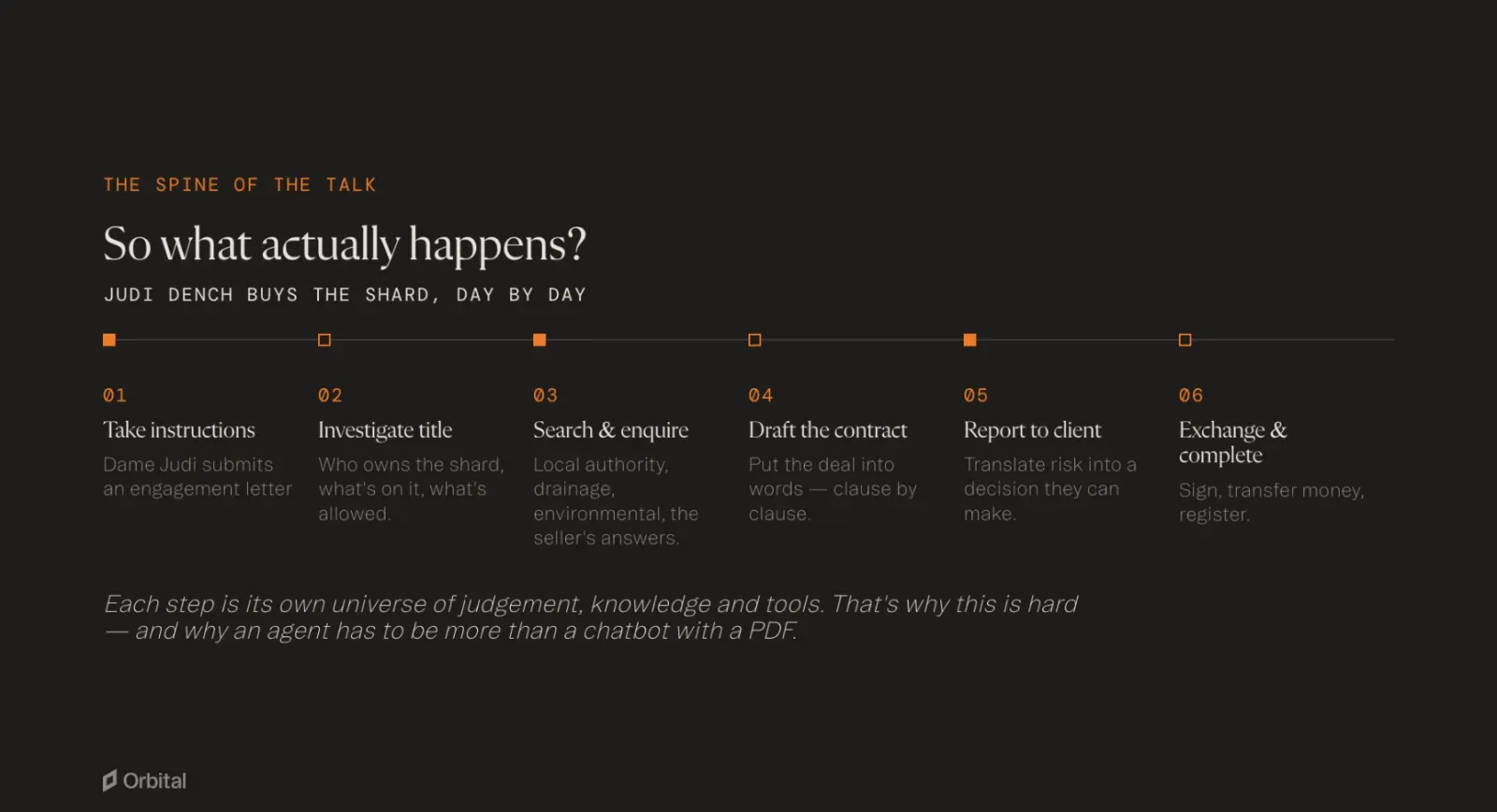
What actually happens when Dame Judi buys the Shard, day by day. Every step is its own universe of judgment, knowledge and tools.
Take instructions. Investigate the title — who owns the Shard, what sits on it, what is allowed. Search and inquire — local authority, drainage, environmental, and the seller’s answers to a long list of pointed questions. Draft the contract, clause by clause. Report the risk back to the client in terms they can actually act on. Then exchange, move the money, and register the new owner.
Each of those steps requires its own universe of judgment, knowledge and tools. That is why real estate is a difficult domain to work in, and it is why an agent that can do it has to be far more than a chatbot with a PDF.
Building the agentic lawyer, step by step
So we walked the room through how you build an agent for each stage of the job — not in the abstract, but with the systems we have actually built or are actively building.

Walking through the build live: how each stage of a property transaction maps onto a capability an agent needs.
Taking instructions
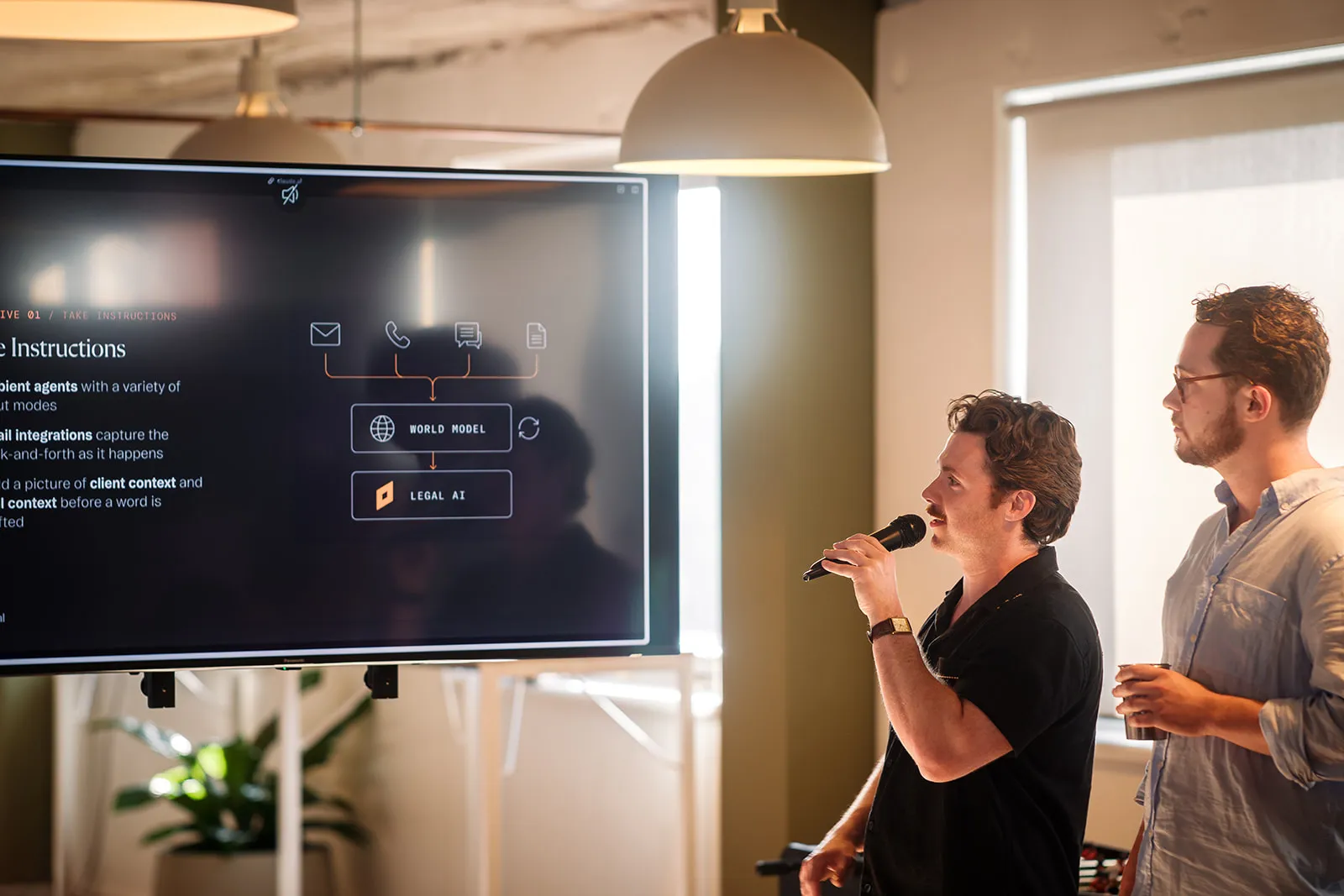
The work starts before a single word is drafted and vital deal context is often locked away in email threads or even phone calls. As shown by agent architectures such as OpenClaw, we are quickly moving toward a world of “ambient agents” — agents that live where the instructions actually arrive — the inbox, the text message, the Slack thread, or even the phone call. Email integrations can capture the back-and-forth of the live transaction as it happens, so the agent is building a picture of both the client and the deal from the very first message, rather than waiting to be handed a tidy brief that may never arrive.
Investigating the title
Next, the agent has to find out what it is dealing with. It can order documents — title, surveys, plans and the like — directly from online portals, whether national, state, county or third-party, and then do its own research: automatically working across county and authority websites, downloading (or even purchasing) what it requires, and reading it all to assemble the full context. This is the unglamorous legwork that a junior lawyer spends hours on, and it is exactly the kind of broad, tool-using, read-everything task that modern agents are genuinely good at.
Giving the agent eyes: the Property Visualizer
A lot of the analysis that occurs as part of a real estate transaction is not performed solely over text. Real estate lawyers frequently have to review maps, plans, and surveys, comparing and contextualizing sites and property features relative to one another visually and spatially.
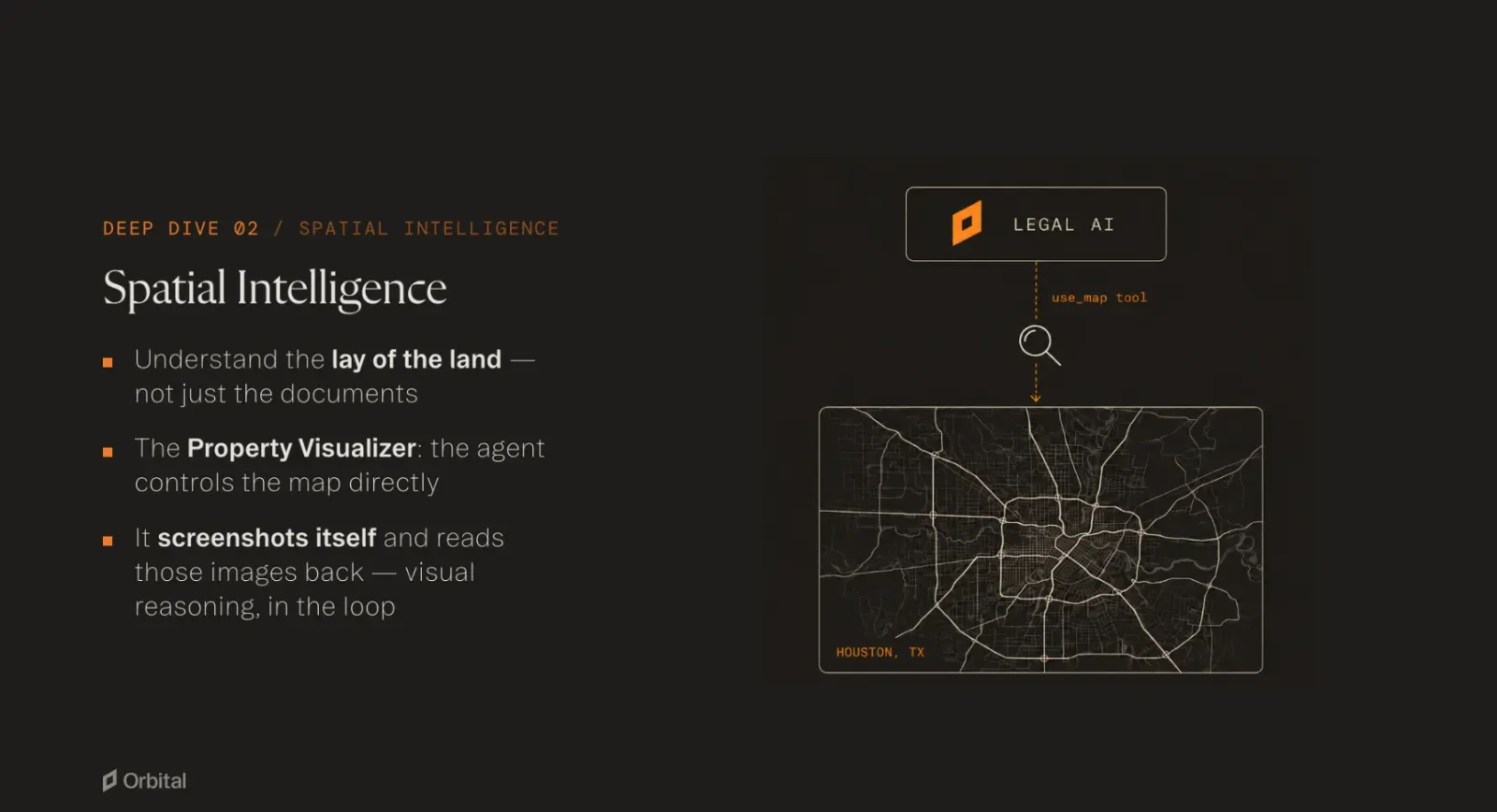
Spatial intelligence: the agent controls the map directly, screenshots itself, and reads those images back — visual reasoning, in the loop.
Our Property Visualizer tool lets the agent control the map directly. It can plot legal descriptions of property boundaries and easements, add annotations, take a screenshot of what it drew, and then read that image back as part of its own reasoning loop. It looks at the world, forms a view, and acts on it — the same way a lawyer would.
Drafting the contract with a team of agents
Drafting is where the interface stays simple but the machinery gets deep. We give the agent the ability to work directly with Word files, the format lawyers actually live in day-to-day. Under the hood, parallel child agents each take responsibility for their assigned sections and propose edits, and a parent agent merges every change in a single pass — then checks the whole thing so that the document stays internally consistent and legally coherent.
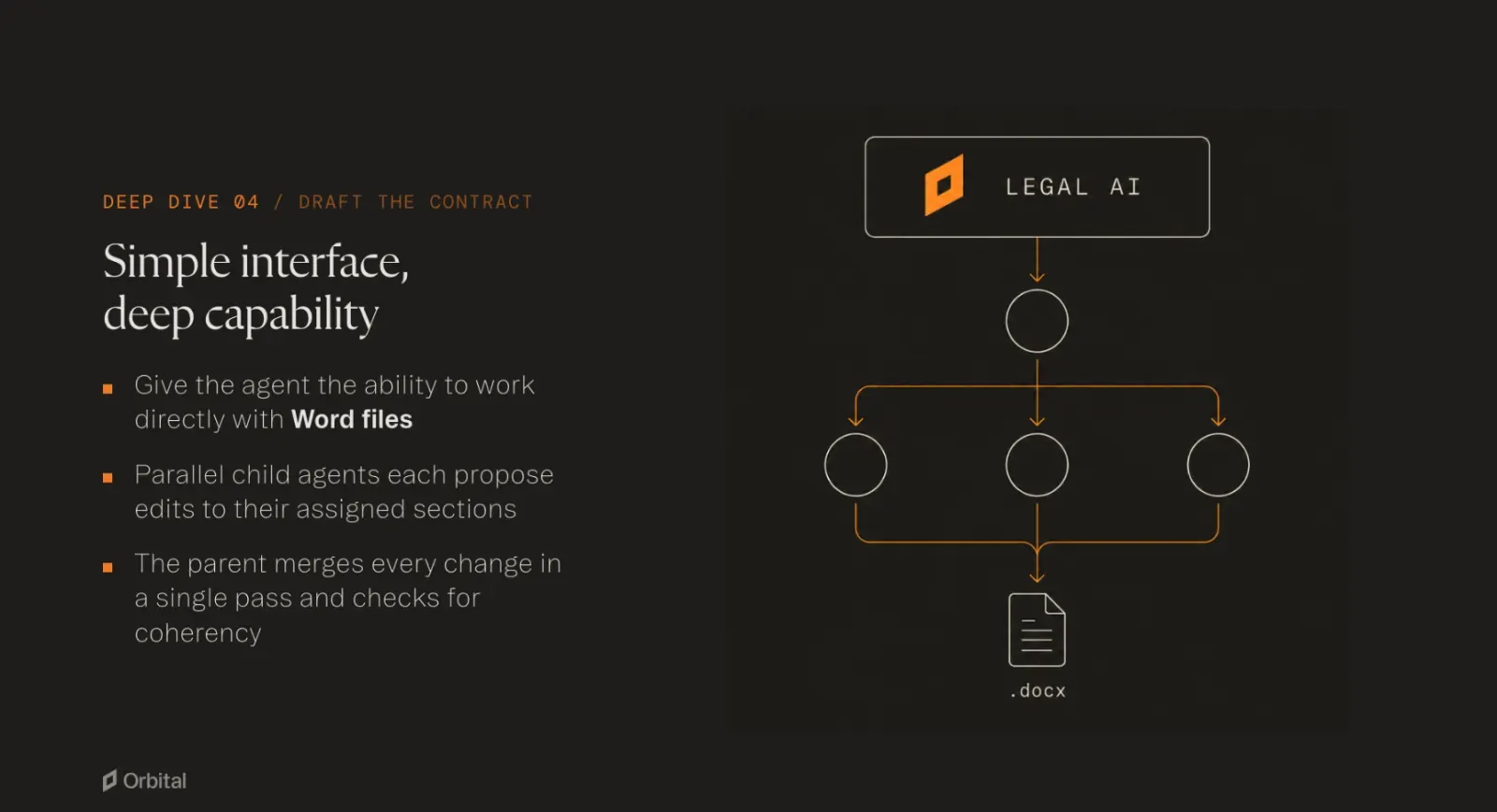
Simple interface, deep capability: parallel child agents each propose edits to their sections; the parent merges and checks for coherency.
A recipe for agents
Stepping back from the individual phases of work, a lesson emerges. A Large Language Model can be thought of as roughly analogous to the brain in our system, the core reasoning engine that decides what the agent should do. But a lawyer is not just a brain. A lawyer is their personal experience, their firm’s collective knowledge and resources, their ability to act on and influence their environment, and, in the case of a real estate lawyer, their ability to see (among many other things).
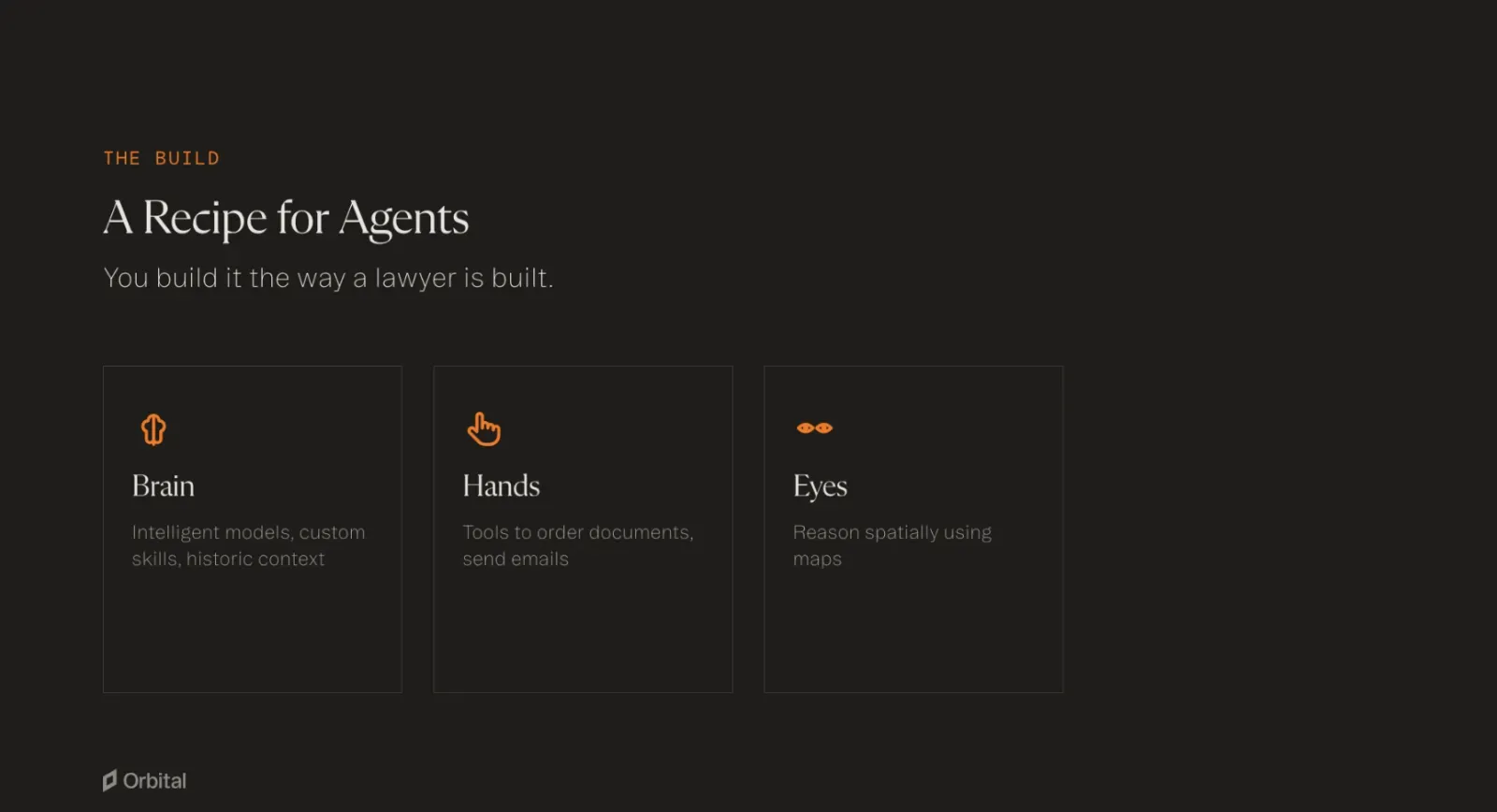
A recipe for agents: you build it the way a lawyer is built — a brain, hands and eyes.
Brain + Mind: Frontier language models, custom skills curated by domain experts, and historic context (memory). The part most “RAG over a document library” demos miss is that a good lawyer carries the firm’s memory, not just their own — past transactions, document templates, house style, the negotiating stance the firm never accepts. Encoding that implicit, firm-level knowledge as retrievable context is where a lot of the real value lives.
Hands: The agent’s tools for taking real action in its environment. Ordering title, searches and plans from live systems; researching the web; drafting clauses, reports and emails; writing to the other side, the client and the bank. It doesn’t just talk about doing things — it does them.
Eyes: the spatial reasoning we have already described, so the agent can reason about maps and place, not only text.
The same playbook, a different domain: harness engineering
Switching focus now from law to engineering, almost everything we just described about the agentic lawyer transfers to how we build our own engineering agents. The industry now has a name for the scaffolding you build around a model — harness engineering.
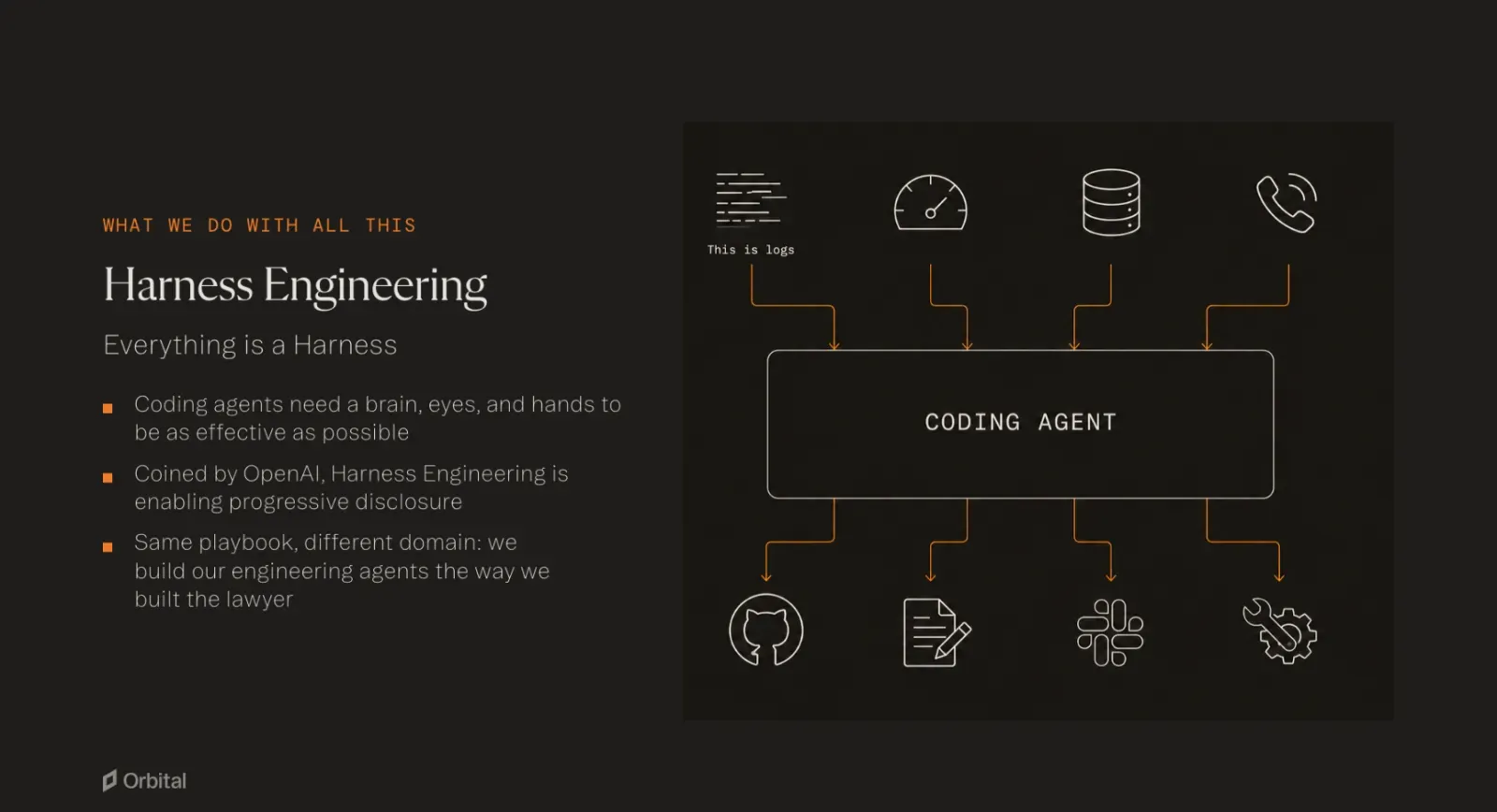
Everything is a harness: coding agents need a brain, eyes and hands too — and the harness is everything you build around the model to provide them.
The model alone is not the product. The value is the harness: the brain, the eyes, the hands — the tools, the skills, the environment you build around it. A coding agent needs all of those to be as effective as a legal one does — so we build our engineering agents with the same playbook we used to build the lawyer. Two of the things that playbook produced are worth showing, because they are the parts we found most useful.
Running while we sleep
One of the more useful things we have deployed is almost boring to describe: cron jobs on a nightly schedule.
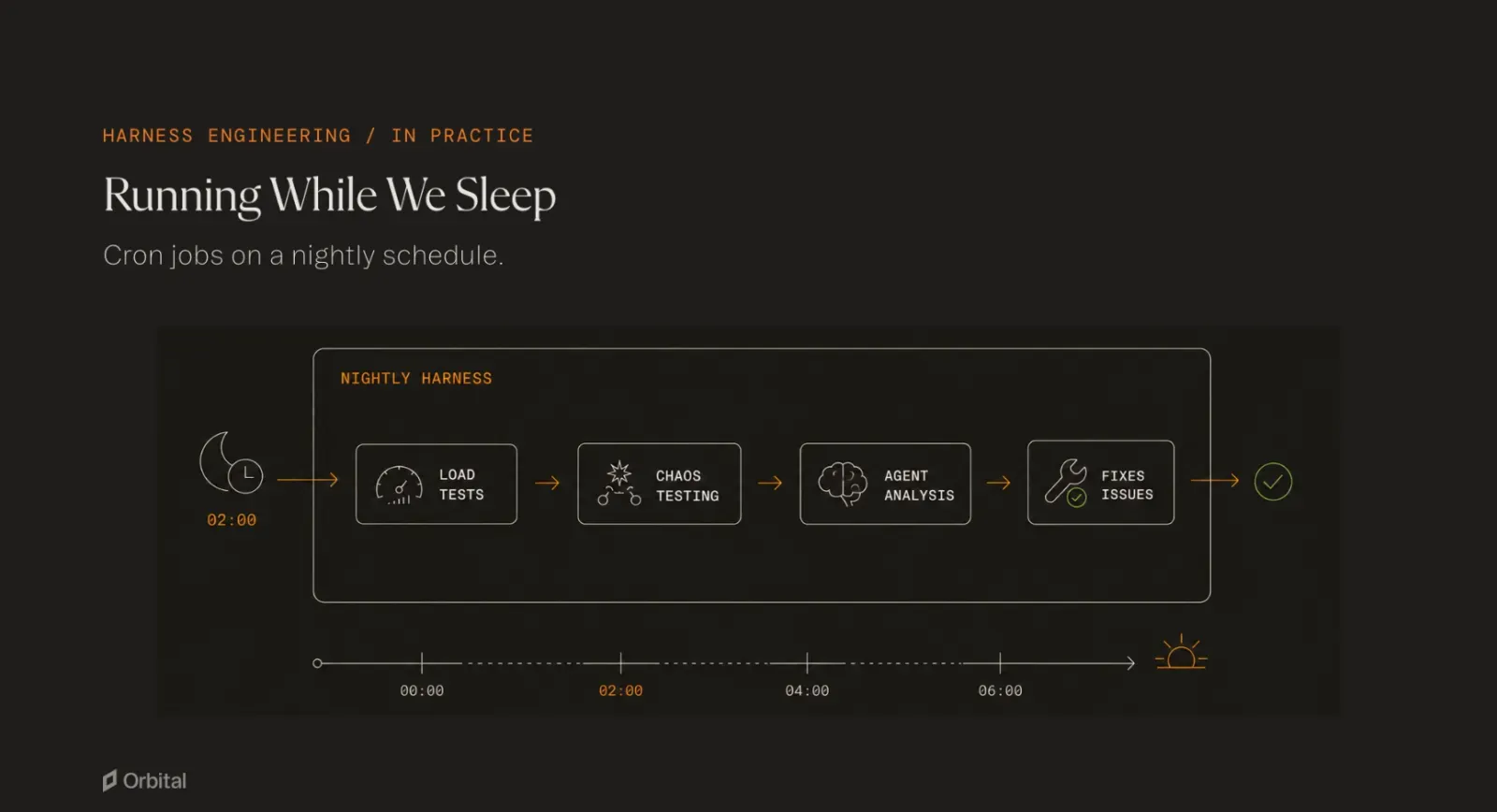
Running while we sleep: nightly load tests, chaos testing, and agents that analyze the results and open fixes before anyone is in the office.
Every night, agents run code quality checks, load tests and chaos testing against our systems, analyze the results, and open fixes — so that on a good morning the pull request explaining last night’s problem is already waiting for us before anyone has had their first coffee.
Self-healing systems
The most ambitious version of that idea is a self-healing loop, designed with user data confidentiality in mind.
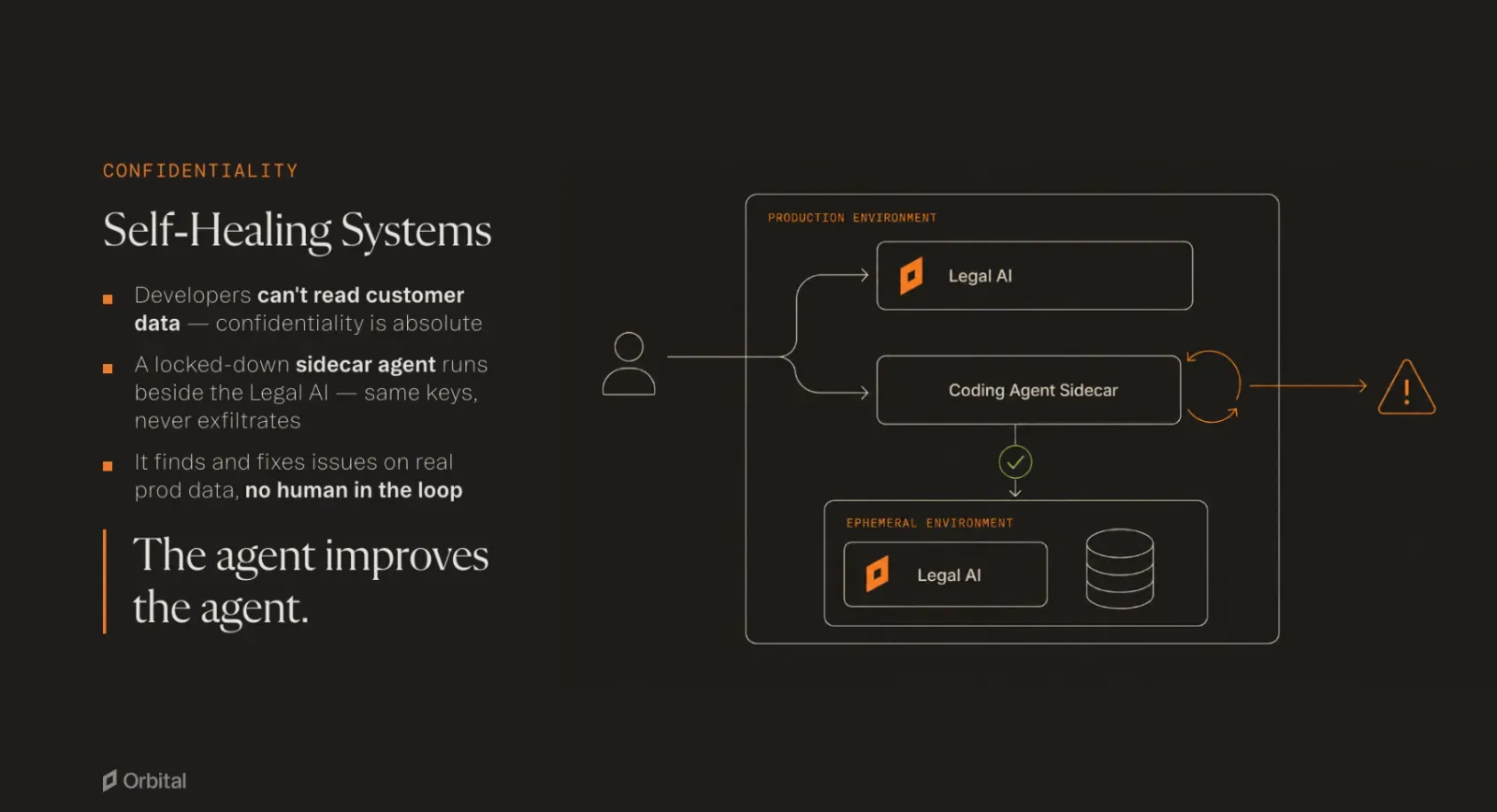
Confidentiality first: a locked-down sidecar agent runs beside the Legal AI, under the same keys, and never exfiltrates. Then the payoff — the agent improves the agent.
In the domain that we work in, confidentiality is absolute: our developers cannot read customer data. A locked-down sidecar agent runs beside the Legal AI — under the same keys, walled in, and it never exfiltrates. It only looks, from inside the wall. Within those constraints it can find and fix issues against real production data in an ephemeral environment, with no human in the loop, and the data never leaves production. The payoff is a nice one to sit with: the agent improves the agent.
Bonus: a property law quiz
They say of presentations, people don’t remember what you said; they remember how you made them feel. Well, nothing makes people feel better than free swag, so we decided to hand out some prizes to audience members who could answer some property-related trivia. The questions are below. Scroll to the bottom of the page for the answers.
- What does mortgage literally mean?
- What is the word used to describe a seller reneging on a deal to accept a higher offer?
- What culinary item gives its name to a nominal token rent?

One happy customer: Sock 2 compliance
So — would you trust an agent to buy your house?

Circling back.
While it may be true that when it comes to high-stakes legal tasks, a qualified human is staying firmly in the loop for the foreseeable, the fact of the matter is that more and more aspects of core legal workflows can be — and increasingly are — performed by specialized agentic AI tools. In the same way that the role and responsibilities of the software engineer have changed radically in the last 6-12 months, we expect the same to be true of the role of the lawyer. So while you may not necessarily trust an AI agent to buy your house, we hope that you would certainly trust a lawyer leveraging the most advanced AI tools to do so on your behalf.
That is the frontier we find genuinely exciting: not a single leap to a fully autonomous lawyer, but a steady accumulation of trustworthy and verifiably correct capabilities. Whether you would hand over the whole transaction today is the wrong question. The right one is which piece becomes trustworthy next — and that is the problem we get to work on at Orbital.
We’re hiring
If building agents that can be trusted with high-stakes, real-world work sounds like your kind of problem — we are actively hiring and would love to talk.
See our open roles on our Careers Page, and if nothing quite matches your experience, connect with me directly on LinkedIn — I am always happy to chat about agents, property law trivia, or both.
Answers: Q1: Dead Pledge, Q2: Gazumping, Q3: Peppercorn
Éanna Morley
Senior AI Engineer
