
How Our Own Product Saved Me Over £10,000
Using Orbital Copilot to challenge a Section 146 notice

March 6, 2026
A few months ago, I received a formal notice that no leaseholder wants to see: a Section 146 notice under the Law of Property Act 1925, sent by recorded delivery. My property management company was alleging I had breached my lease by failing to resolve a water leak affecting the flat below mine.
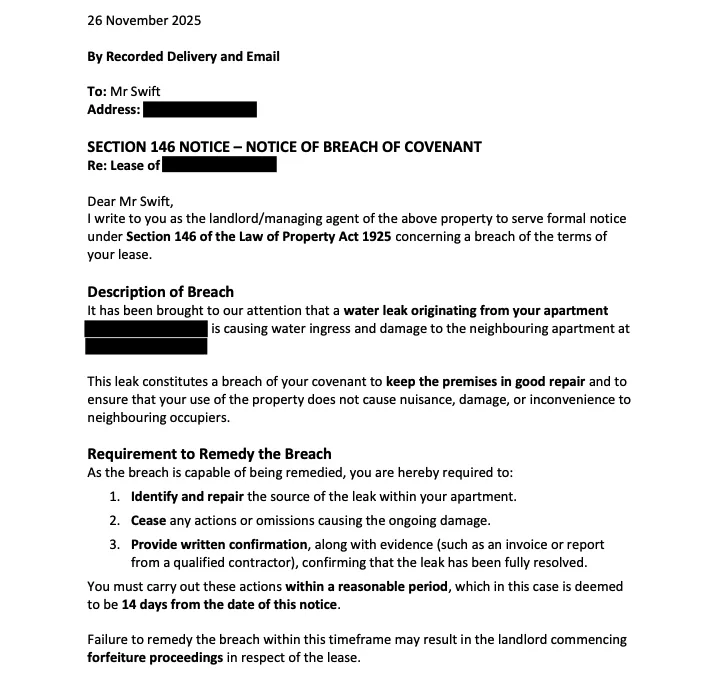
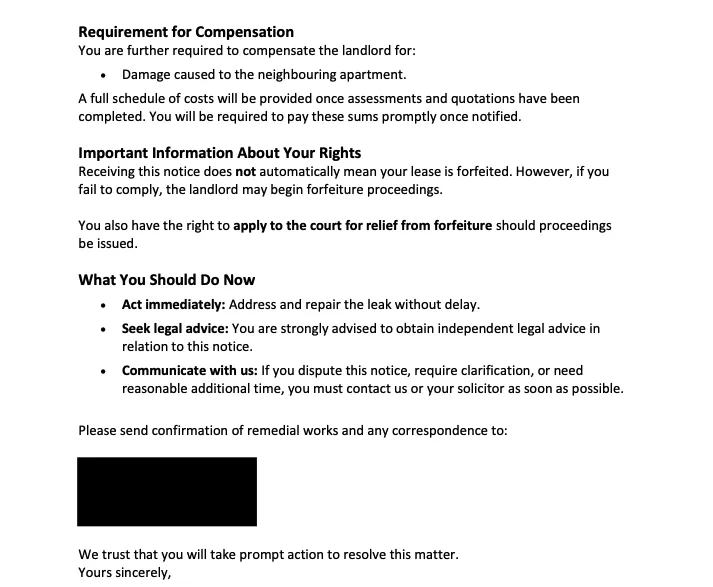
The notice did not pull its punches. It alleged a breach of my covenant to keep the premises in good repair, demanded I identify and fix the source of the leak within 14 days, required me to pay compensation for damage to the neighbouring flat, and warned that failure to comply could result in forfeiture proceedings. In other words: fix it, pay for the damage, or risk losing your home. To be honest… I was worried!
I am not a lawyer. I do not have a background in property law or residential conveyancing. Like most leaseholders, I had barely read my lease beyond the bits about rent and service charges. So when a two-page legal notice landed on my doormat, my first instinct was to accept what I was being told, find a contractor, and start spending money.
But something did not sit right. The leak appeared to be coming from beneath the surface of my roof terrace, not from anything I had done or failed to maintain on top of it. So before reaching for my wallet, I reached out to a colleague on our legal engineering team for some advice, and ran my lease through Orbital Copilot to see what I could uncover.
What Orbital Copilot found
I uploaded my lease and asked a simple question: who is actually responsible for this?
Within a short space of time, I had a clear breakdown of the lease’s definitions, my obligations versus the management company’s obligations, and the exact clauses that mattered. It turned out that my responsibilities as a leaseholder only extended to the surface finishes of the terrace: the paving and tiles I walk on. Everything underneath (the waterproofing membrane, the roof build-up, the structural slab) was explicitly defined in the lease as “Structural Parts.” And maintaining Structural Parts? That was the management company’s obligation, funded through the service charge.
The back and forth
Armed with that analysis, I wrote back to the management company with verbatim lease extracts and a structured legal argument, asking them to withdraw the Section 146 notice. They pushed back, arguing that a waterproofing membrane should not count as a “structural” element and that their interpretation of the lease was different from mine.
So I went even deeper with Orbital Copilot. I pulled the exact contractual definitions, cited every relevant clause, and attached the executed lease and title documents. I pointed out that the lease contains its own explicit, exhaustive definition of “Structural Parts” that clearly includes roofs and terrace structural elements, and that this contractual definition governs, not a general engineering interpretation.
Their response? They escalated it to their lawyers.
The outcome
Months passed. Then, just this week, I received a call from the management company confirming that they are, as I had argued, fully responsible for resolving the issue.
Without Orbital Copilot, I would not have had the knowledge or the time to challenge their position. I had been quoted in excess of £10,000 by contractors to investigate and repair the terrace, let alone the cost to repair the damage to the neighbouring apartment. That is money I would have spent fixing something that was never my responsibility in the first place. Instead, I was able to hold my ground with confidence, because for the first time I actually understood my lease.
What this taught me
My lease is not unusual. It is a standard residential long lease. The clauses I relied on are common. The definitions are typical. Yet the management company themselves appeared not to have read them carefully, or at least hoped that I had not.
That is the gap Orbital Copilot closed for me. It didn’t just surface information. It gave me the understanding and the confidence to act on it. In the time it takes to make a cup of coffee, I went from confused and worried leaseholder to someone who could engage with a property management company on equal footing, with precise legal references to back up every point.
The bigger picture
I work at Orbital, so I had easy access to Orbital Copilot. But this experience crystallised something. If our tool can do this for one person navigating a residential lease dispute, imagine what it is doing every day for lawyers at major firms who are reviewing hundreds of contracts, identifying obligations across complex transactions, and advising clients where millions are at stake.
The difference between understanding your documents and not understanding them is not academic. It is measured in money, in stress, and in outcomes. That is what we are building for.
Conrad Swift
Principal Talent Lead
