
Everyone Ships Code Now
How Orbital is adapting to the age of agentic coding

February 11, 2026
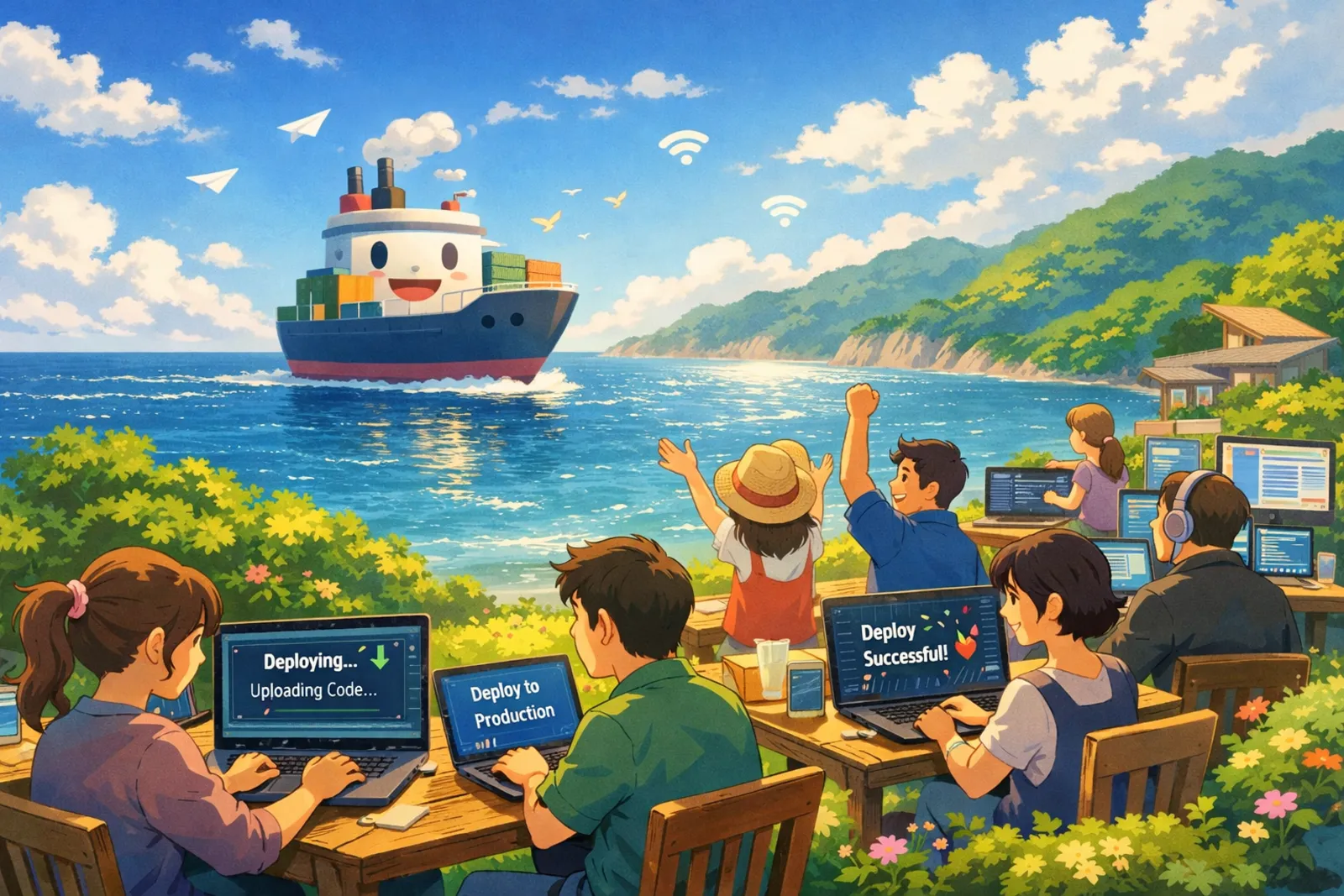
Something shifted over Christmas 2025. Anthropic released Opus 4.5 on November 24th, but it took about a month—over the holiday break, when everyone had some downtime to experiment—for the world to truly wake up to what had changed. The combination of Opus 4.5’s intelligence and Claude Code’s ability to harness that model for software engineering meant the majority of code could now be written by AI agents. At Orbital, we’ve spent the weeks since adapting to this new reality—and the implications are profound.
The industry is waking up
The signals from leaders in the AI community have been impossible to ignore.
Andrej Karpathy, formerly of Tesla and OpenAI, captured the shift perfectly: he went from 80% manual coding and 20% agents in November to 80% agent coding and 20% manual edits by December. “I really am mostly programming in English now, a bit sheepishly telling the LLM what code to write… in words. It hurts the ego a bit but the power to operate over software in large ‘code actions’ is just too net useful.”
Boris Cherny, who leads the Claude Code team at Anthropic, shared something even more striking: “Pretty much 100% of our code is written by Claude Code + Opus 4.5. For me personally it has been 100% for two+ months now, I don’t even make small edits by hand. I shipped 22 PRs yesterday and 27 the day before, each one 100% written by Claude.”
Roon, Member of Technical Staff at OpenAI, put it bluntly: “programming always sucked. it was a requisite pain for ~everyone who wanted to manipulate computers into doing useful things and I’m glad it’s over. It’s amazing how quickly I’ve moved on and don’t miss even slightly.” When asked what percentage of his coding is done by AI, he replied: “100%, I don’t write code anymore.”
And Aaron Levie, CEO of Box, highlighted perhaps the most provocative implication: you can hand off more and more to the agent today even if it’s not the cleanest code, because future model updates will allow the agent to go back and make it all better anyway. “This is going to break a lot of brains because it’s the opposite of anything that would have been comfortable in the past.”
What this means for how we build software
For years, the bottleneck in software teams has been “how fast can we get ideas built in code.” That’s why traditional cross-functional teams are engineering-heavy: one product manager, one designer, and the rest frontend, backend, or full-stack engineers. That ratio is shifting dramatically.
When AI can generate most of the code, the constraint moves upstream. The new bottlenecks become:
- Judgment and taste: knowing what’s good versus what’s merely plausible
- Problem definition: understanding users deeply enough to know what to build
- System design: orchestrating AI capabilities into coherent products
The fundamentals of building good products—understanding users, making tradeoffs, shipping—don’t change. But the role of the human shifts from writing code to directing AI agents that write code.
How Orbital is adapting
We’ve been running experiments internally under the banner of “Project 100x”—exploring how far we can push agentic, swarm-based engineering. Here’s what we’re changing:
Tiny teams
We’re moving from large cross-functional squads of eight people (product manager, tech lead, engineers, legal engineers, designer) to tight-knit teams of 2-4 people who combine product, design, and engineering. When everyone can ship code through AI agents, you need fewer specialists and more generalists who can own outcomes end-to-end.
New hiring criteria
We’ve redefined what we look for in candidates. Three attributes matter more than ever:
AGI-pilled: Believes we are on the edge of something extraordinary. Understands that ever-increasing AI capability should shape what we build, how we build it, where we invest, and who we hire.
Demonstrated excellence in something: Has reached a high level in any domain—academic, athletic, creative, professional, or personal projects. The domain matters less than proof of the ability to achieve excellence.
Generalist mindset: Willing to cross role boundaries. A product manager who ships code. An engineer who talks to customers and thinks through roadmap concepts. A designer who implements their own frontend.
Everyone ships to production
We’re working toward a world where anyone in the organization—product managers, designers, legal engineers—can ship code to production. Eventually, we’d like this to extend beyond the product engineering team: customer success managers fixing a workflow issue, or go-to-market team members prototyping a new idea. AI agents write the code, AI agents review the code, and humans provide judgment, direction, and quality oversight.
This doesn’t mean engineers disappear. The task of coding changes, but the job of problem-solving doesn’t. Engineers increasingly become orchestrators of fleets of agents, verifying the impact of the agent’s work, pulling the agent back when they’ve made too many changes, and focusing on the problems that matter most.
The path forward
We’re still learning. Much of what we’re trying is R&D—experiments that might not work out. But the patterns we discover will flow back into everyone’s day-to-day development.
The world is moving fast. As Karpathy noted, this is “easily the biggest change to my basic coding workflow in ~2 decades of programming and it happened over the course of a few weeks.” We’re taking this very seriously and adapting accordingly.
We’re hiring people who are excited about this future. If you’re AGI-pilled, have demonstrated excellence in something, and want to work across boundaries in a fast-moving environment, check out our open positions.
Andrew Thompson
CTO


