
From Orbital to YC
How AI Engineering at Orbital prepared me to found a YC-backed startup

December 24, 2025
We’re hiring! Explore our Product Engineering Guide to learn how we build at Orbital.
When Orbital first reached out, building AI in real estate law didn’t exactly set me alight. But I decided to give the interview a go, and it’s still the only interview I have ever enjoyed: a high quality team, and a brainstorming task that simulated what it’s like to be in the role, which I loved. I could see how much I’d learn if they gave me the chance. In the end, it was a complete no-brainer.
I joined wide-eyed and green. My background was more analagous to research than industry: NLP work at Oxford University on government-funded phone fraud detection, then ML engineering at a spinout focused on career exploration. I had trained models and built MVPs, but never shipped features to production that real, paying users would touch immediately.
At Orbital, the AI Engineer role sits with one foot in data science and the other in software engineering. One of Orbital’s mantras is shipping early and often, which they live up to. Customer impact is at the forefront: both in providing new capabilities quickly and ensuring a seemless experience, given the increasing number of lawyers relying on Copilot, our flagship AI real estate lawyer. It was a baptism of fire.
Learning by Doing, Across Three Teams
I worked across three engineering teams during my time at Orbital: UK, US, and R&D. I also joined sales and customer success calls to understand our users’ pain points firsthand.
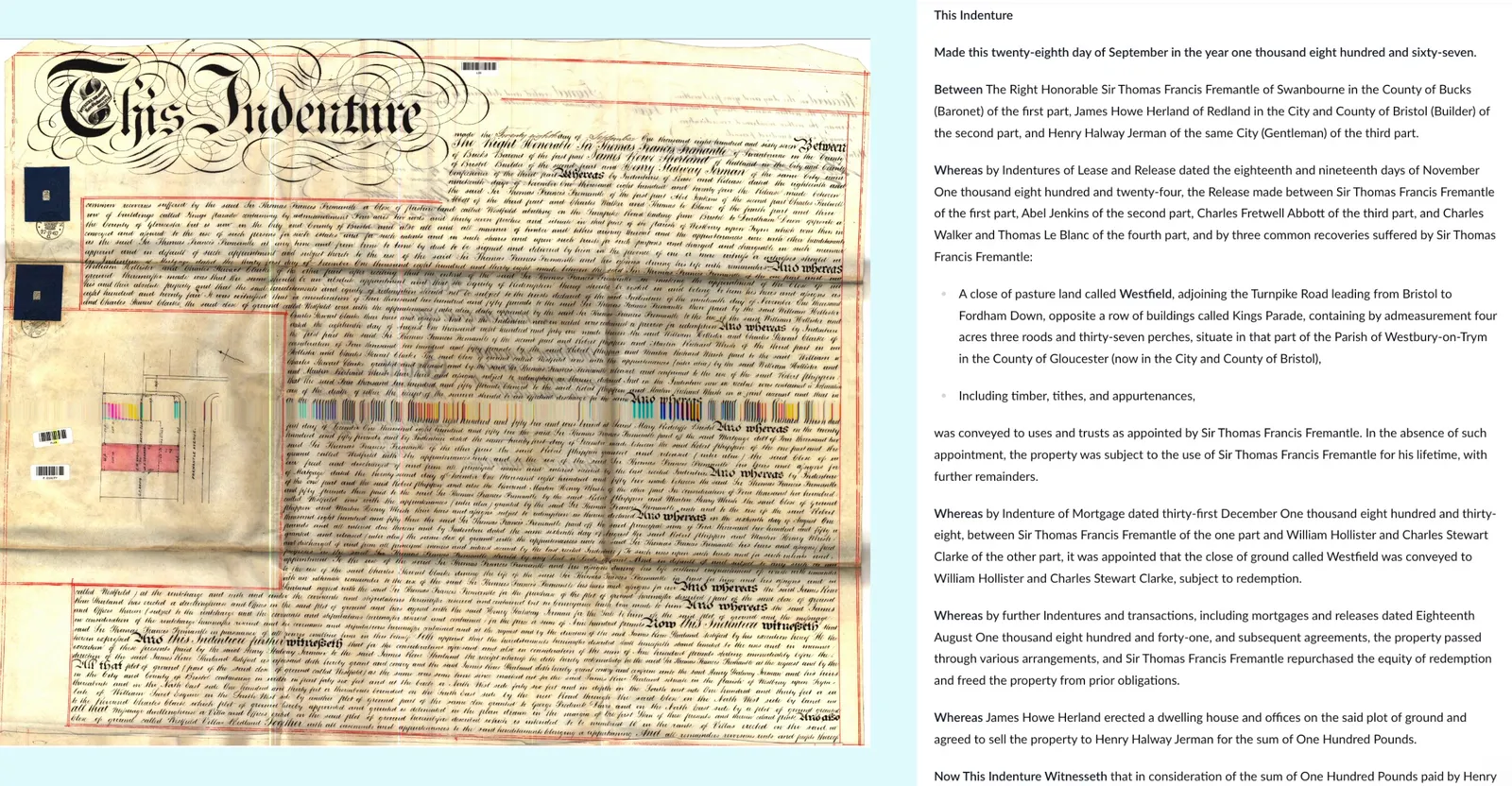
On the UK team, my early projects involved using vision-language models to create digital representations of poorly scanned property documents. These were the kind of PDFs that law firms would literally have rooms of people tracing over on light tables just to make legible.
When the company began its push into the US market at the start of 2025, I was moved to the US team in the hunt for product-market fit (PMF). The real estate legal landscape is substantially different to the UK, and I needed to rebuild the way we bundle property legal documents together to support US workflows for generating due diligence reports. It was crucial to having a viable solution.
This involved building from first principles: reframe the problem, go deep on all the available options, strike them out as they aren’t viable, set up mini evals to evaluate the most promising approaches, and finally push a finished system to production. That system became the foundation of our Title Review product, which enabled us to find PMF in the US and drive rapid commercial traction within a year.
There was no formal process dictating these steps; it just made sense for this project. From my experience of AI engineering at Orbital, you address problems with whatever steps you deem most necessary, rather than process for the sake of process. The result is moving incredibly fast from idea to a truly valuable user-facing product.
Recently, I moved to a more R&D-focused team, led by our VP of AI, Matt Westcott. Matt and I started scoping out terminal-based agent architectures in January 2025, long before terminal agents were obvious. In May, with Matt’s support, I validated our ideas by spending 36 hours hacking together a due diligence report agent. Inspired by Claude Code’s general capability, I ran Claude Code in a loop in a subprocess, piping inputs and outputs to a basic app, overriding the system prompt to something real estate focused. In hindsight, I’d built the essence of what Anthropic would later release as the Claude Agent SDK. This led to Matt writing Give Your LLM a Terminal (well worth the read), and sparked a company-wide architectural rethink. This has resulted in some incredible new capabilities that I can’t say too much about yet, but will hopefully be dropped soon (apologies, no spoilers here)!
Initiative Gets Rewarded
I felt encouraged to explore other areas as long as my projects were on time.
Inspired by ChatGPT’s memory feature, I built a memory prototype over a weekend for our platform. I pitched it to the product team with a working demo and the reception was overwhelmingly positive. Memory is now on the strategic roadmap.
I also wrote several blog posts for the company website on topics I naturally wanted to write about: a piece on mechanistic interpretability, explainers on how LLMs and agents work under the hood, and a description of how we approach evals. Everyone it seemed, from the CTO to Legal Engineers (our ex-lawyers) and sales, were willing to give feedback and share the pieces once published, which meant a huge amount.
Investment in Growth
Orbital supported me in pursuing opportunities outside day-to-day work. I got into a McKinsey x QuantumBlack 48-hour hackathon through LegalTechTalk and was given the time to go. I learned a huge amount and met representatives from Legora (including their CEO Max), which was incredibly valuable given our legal focus.
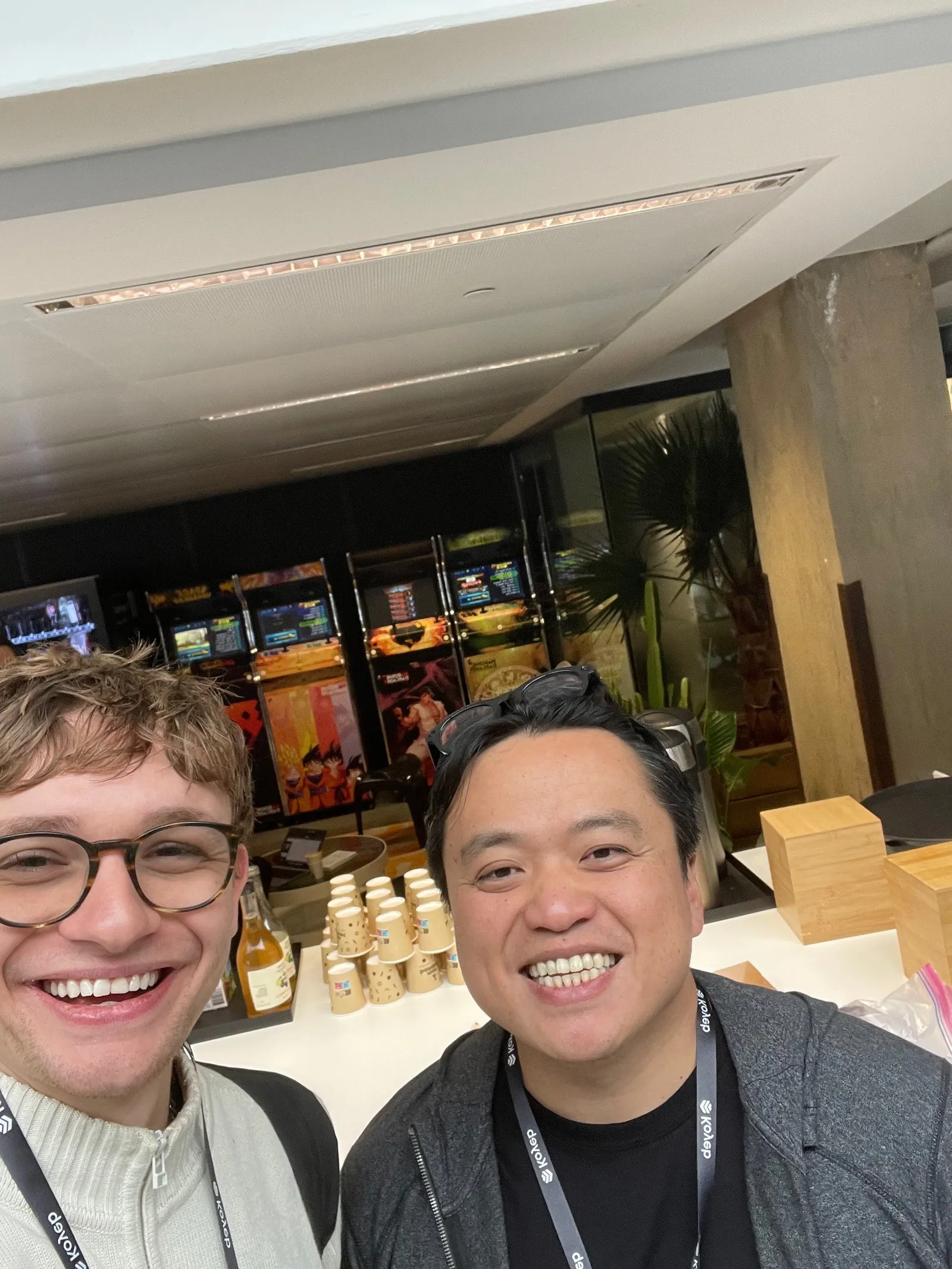
In September 2025, myself and two others from the R&D team went to the AI Engineer conference in Paris. We were given the time off and could use our learning and development budget to cover expenses. Everyone at Orbital has a £1,000 L&D budget per year, which for me has been a crazy unlock. Every time I’ve seen an interesting book, subscription, or product, I’ve been able to get it immediately.
Mentorship that actually mattered
Matt was my manager throughout. He has had an unusual path into AI: an aspiring philosopher who grew disillusioned, pivoted to law school, only to drop out to become a professional poker player. It was then that he got into ML, training poker bots and moving to the space professionally. Aside from being incredibly kind and great fun, he’s one of the deepest thinkers I’ve encountered in AI, and the most plugged-in person to the space that I have ever met. His mentorship has been fundamental to my development.
We had 30-minute one-on-ones each week, as everyone does with their manager at Orbital. I asked for a tight feedback loop: tell me honestly how I’m doing, where I’m falling short, what I should work on.
Those conversations were some of my favourite moments at the company. They are where we developed a mantra that became central to the AI team: Truth over Tact. Prioritise raw honesty on your take over attempted diplomacy. Whether it’s a project, when dealing you’re dealing with colleagues, explaining the status of things, just be honest. It’s something that has resonated hugely and that I’ll carry with me beyond Orbital.
A Culture Built for a Fast-Moving Field
The weekly AI brainstorms were invaluable. I was involved in three per week, each 30 to 45 minutes, spanning engineering and product teams. We’d discuss recent news, what looked exciting or disconcerting, how it related to current projects, what it meant for the roadmap. People demoed work in progress. The underlying technology moves so fast that without dedicated space to filter signal from noise, it’s easy to fall behind. These sessions kept us sharp and fed the best ideas back into the product.
Over time, I started attending AI events around London, and it struck me how I never seemed to meet anyone more on the pulse of application-layer AI than our team. This gave me a huge amount of confidence and reinforced my belief that the AI team at Orbital is world class.
What’s Next
That confidence was invaluable when applying to Y Combinator as a co-founder. I have always aspired to found, and my time at Orbital was pivotal in making it happen.
I’m now co-founder and CTO of Balance AI, a full-stack AI accountancy firm for SMBs. We use AI agents to handle the accounting grunt work, which our human accountants review while spending most of their time actually talking to clients. The result is a faster, cheaper, and more personal experience than traditional services. We have customers in Denmark, the US, and the UK. There are countless lessons I have learned at Orbital that I will take with me to Balance.
Leaving is bittersweet, as I loved the team. I’m grateful they bet on me, gave me the opportunity to develop, and supported me through this next step.
If you’re curious but not yet convinced, give the interview a go. I’m glad I did.
We’re hiring
If you are interested in helping us solve some very hard problems building the world’s first AI-powered real estate lawyer, see our open roles and get in touch with us via our Careers Page. If nothing quite matches your experience please connect with and message me directly on LinkedIn, Andrew Thompson, and I’d be happy to have a chat with you.
Gus Levinson
AI Engineer
